What Is DTF Printing? A Complete Guide for Sri Lanka
A plain-English guide to DTF printing in Sri Lanka: how direct to film transfers are made, what they print on, how to prepare artwork, what transfers cost and how to press them.
In this guide 10 sections
- What DTF printing actually is
- How the DTF process works, step by step
- What you can print on with DTF
- DTF printing Sri Lanka prices: what transfers cost
- Preparing artwork that prints well
- How to press a DTF transfer
- Strengths and limits of DTF
- Buy transfers or buy a DTF printer?
- Frequently asked questions
- Ready to try DTF?
If you have ordered a custom t-shirt recently, or looked into starting a small clothing line, you have probably heard the letters DTF. This guide explains DTF printing in Sri Lanka in plain terms: what it is, how the process works, which fabrics it suits, what artwork it needs, how much transfers cost at the time of writing, and how to press them properly so the print lasts.
Print Right has been in the printing trade in Colombo since 2007, and we both sell DTF equipment and print DTF transfers for customers. By the end of this article you should be able to decide whether DTF fits your project and prepare a file you can send for printing today.
What DTF printing actually is
DTF stands for direct to film. Instead of printing straight onto a garment, a DTF printer prints your design onto a clear PET film. The printer lays down colour ink (cyan, magenta, yellow and black) and then a layer of white ink behind it. The white layer is what lets a DTF print look bright and solid on black or dark-coloured fabric.
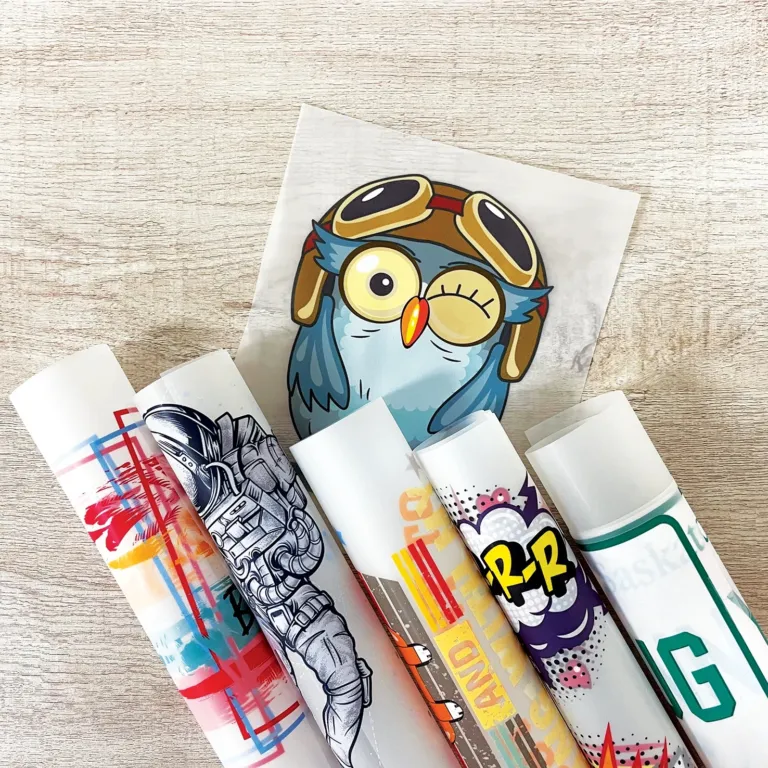
While the ink is still wet, the film is coated with a fine hot-melt adhesive powder. The powder sticks only to the inked areas. The film is then heated to melt and cure the powder. What you are left with is a transfer: a sheet of film carrying your design, ready to be pressed onto a t-shirt, tote bag, hoodie or other item with a heat press.
Because the design is only cut out by its own shape, there is no need to weed away background material the way you would with vinyl, and there is no screen to make for each colour the way there is with screen printing. A full-colour photo costs the same to print as a one-colour logo of the same size.
How the DTF process works, step by step
- Artwork is prepared as a transparent PNG at actual size and 300 DPI.
- The design is printed onto PET film, colour first and white on top, in mirror image so it reads correctly once transferred. When you order from us, we mirror the file for you.
- Adhesive powder is applied to the wet ink and the excess is shaken off. Printers such as our 30 cm dual-head DTF printer have a built-in powder shaker that does this automatically.
- The powder is cured with heat so it becomes a smooth adhesive layer.
- The transfer is pressed onto the garment with a heat press at the right temperature, time and pressure.
- The film is peeled once it has cooled completely, leaving the design bonded to the fabric.
Steps 1 to 4 happen at the printer. Steps 5 and 6 can happen anywhere you have a heat press, which is why you can buy ready-made transfers and do only the pressing yourself.
What you can print on with DTF
The main advantage of DTF is its range. It works on cotton, polyester and cotton–polyester blends, in light or dark colours. Sublimation, by comparison, needs white or light polyester or a polymer-coated surface. The table below shows the pressing settings from our Help Center. Treat them as starting points and always test on a spare piece first, because presses and fabrics vary.
| Material | Temperature | Time | Notes |
|---|---|---|---|
| Cotton | 160 °C | 25 seconds | Firm pressure; cool completely before peeling |
| Cotton–polyester blend | 150 °C | 20 seconds | Teflon sheet recommended |
| Polyester | 140 °C | 15 seconds | Lower heat avoids scorch marks and shine |
| Nylon | 135 °C | 15 seconds | Pre-press; cover with parchment |
| Leather | 130 °C | 12 seconds | Light to medium pressure |
All of these are cool peel: let the transfer cool fully before lifting the film. Peeling while the transfer is still hot can make the print lift at the edges.
DTF printing Sri Lanka prices: what transfers cost
You do not need your own printer to use DTF. We print transfers from your artwork and you collect them from the showroom at 382 Galle Road, Colombo 06, or ask us about delivery. These are our published prices at the time of writing. Please check the DTF printing page for today’s price before you budget.
| Size | Print area | Price | Bulk price |
|---|---|---|---|
| A4 sheet | 8″ × 11″ | LKR 240 per sheet | LKR 200 per sheet from 51 sheets |
| A3 sheet | 11″ × 16″ | LKR 450 per sheet | LKR 400 per sheet from 51 sheets |
| Gang sheet, 11″ wide | 11″ × 39″ per metre | LKR 1,200 per metre | LKR 1,000 per metre from 16 m |
| Roll, 22″ wide | 22″ × 39″ per metre | LKR 2,400 per metre | LKR 2,000 per metre from 16 m |
A custom medium size of 22″ × 12″ is also available; ask on WhatsApp for details.
Worked example: 40 t-shirts for a cricket club
Say a club wants 40 t-shirts with one front design that fits inside 8″ × 11″.
- Transfers: 40 A4 sheets × LKR 240 = LKR 9,600, which is LKR 240 per shirt for the print.
- Blank t-shirt: your quote per shirt (fill in the price you are given for the blank).
- Your time, packaging and delivery: your own figure per shirt.
Cost per shirt = LKR 240 + blank price + your extras. Once you know that number, you can set a selling price that covers it with a margin.
A tip on the bulk threshold
Look at where the bulk price starts. At the time of writing, 50 A4 sheets at LKR 240 come to LKR 12,000, while 51 sheets at LKR 200 come to LKR 10,200. In the same way, 15 metres of gang sheet at LKR 1,200 is LKR 18,000, while 16 metres at LKR 1,000 is LKR 16,000. If your order sits just under a threshold, adding a few extra prints for spares can lower the total.
For small designs such as pocket logos or name labels, a gang sheet usually works out cheaper per print than individual A4 sheets, because you can fit many designs on one metre. Our guide to DTF gang sheets shows how to lay them out.
Preparing artwork that prints well
DTF prints exactly what is in your file, so the quality of the file decides the quality of the result. Our DTF artwork requirements page covers the details. Here is the short checklist:
- Transparent PNG with no white box around the design. A PDF of a background-removed PNG is also accepted.
- 300 DPI, designed at the actual size you want it printed (1:1).
- CMYK colour mode.
- Fonts converted to outlines.
- No screenshots or low-resolution images pulled from social media.
- Keep a 0.25″ safe margin inside the print area.
- Do not mirror the artwork yourself; we mirror it before printing.
Check your file carefully before sending it. Orders are printed from the file you send, and once printing starts, changes cannot be made. For a longer list of pitfalls, read 9 artwork mistakes that ruin DTF prints.
How to press a DTF transfer
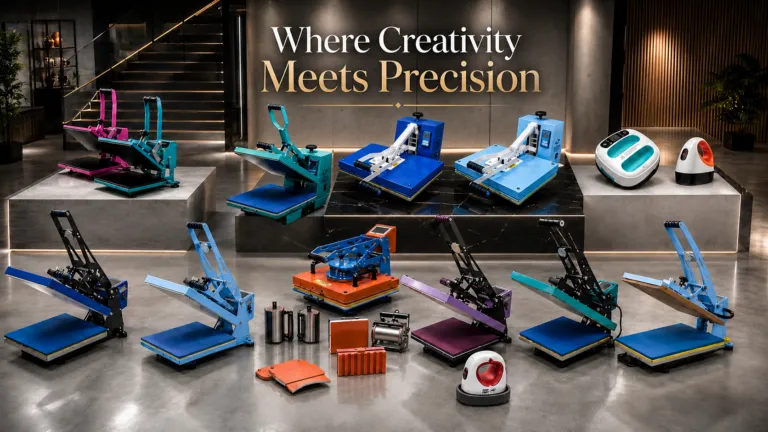
A flat-bed heat press gives even heat and pressure across the whole design, which matters for larger prints. A 15″ × 15″ press is a practical size for adult t-shirt fronts; you can browse our flat-bed heat press machines to compare sizes.
- Set the press to the temperature and time for your fabric (see the table above).
- Pre-press the garment for a few seconds to remove moisture and creases.
- Place the transfer adhesive side down, film side up, and check it is straight and centred.
- Cover with a Teflon sheet or parchment where recommended.
- Press with firm, even pressure for the full time.
- Let it cool completely, then peel the film slowly and smoothly.
- Inspect the edges. If any small area lifts, cover and press again briefly.
For care, the usual advice is to wash printed garments inside out in cool water and avoid ironing directly over the print.
Strengths and limits of DTF
DTF is not the right answer for every job, so it helps to be honest about both sides.
Where DTF works well:
- Full-colour and photographic designs, with no extra cost per colour.
- Dark garments, thanks to the white ink layer.
- Small and mixed orders, such as different names or sizes of design on each shirt.
- Cotton, which sublimation cannot print on.
- Stock-free selling: you can keep transfers ready and press only when an order arrives.
Where to think twice:
- Very large solid areas of print can feel heavier than the fabric around them.
- For all-over prints on white polyester sportswear, sublimation is usually the better fit.
- For very large runs of a simple one-colour design, it is worth also getting a screen printing quote to compare.
Our comparison of DTF vs sublimation vs screen printing vs HTV goes through these choices in detail.
Buy transfers or buy a DTF printer?
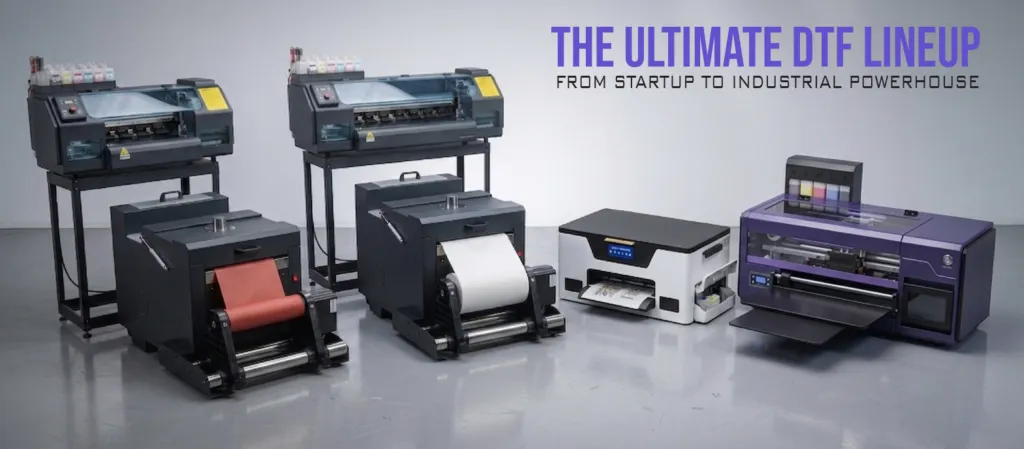
Most people start by ordering transfers, because it needs only a heat press and good blanks such as our 220 GSM premium cotton t-shirts. Owning a printer makes sense once you have steady volume and the time to run and maintain it, since a DTF printer also needs film, white ink, colour ink and powder. If you reach that point, look at our DTF printers, which come with installation, training and spare parts, and are quoted on the day because prices move with the exchange rate. You are welcome to visit and watch one run before deciding.
Frequently asked questions
Does DTF printing work on black t-shirts?
Yes. A DTF transfer has a layer of white ink behind the colours, so designs stay bright on black and other dark fabrics, as well as on light colours.
What file should I send for DTF printing?
Send a transparent PNG at 300 DPI, designed at actual size, in CMYK, with fonts converted to outlines and a 0.25 inch safe margin. Do not mirror it, because we mirror the artwork before printing.
How much does DTF printing cost in Sri Lanka?
At the time of writing, our A4 sheets are LKR 240 each (LKR 200 from 51 sheets) and 11 inch gang sheets are LKR 1,200 per metre (LKR 1,000 from 16 metres). Check the DTF printing page for today’s price.
Can I press DTF transfers without a heat press?
A household iron cannot give the even temperature and firm pressure a DTF transfer needs, so results are unreliable. A heat press set to the right temperature and time is the dependable way to apply them.
Is DTF better than sublimation?
Neither is better for everything. DTF works on cotton, blends and dark colours, while sublimation suits white or light polyester and coated items such as mugs, where the ink becomes part of the surface.
Ready to try DTF?
Prepare your artwork using the checklist above and send it to us on WhatsApp at 077 762 8679. You can collect your transfers from our showroom at 382 Galle Road, Colombo 06, or ask about delivery. If you are thinking about pressing your own shirts or buying a printer, visit the showroom and we will show you the process in person.