Sublimation Mug Printing in Sri Lanka: Start a Gift Business
How to start a photo mug and personalised gift business: how sublimation works, the equipment list, step-by-step mug pressing at 180 °C, a troubleshooting table and settings for tiles, glass, rocks and crystals.
In this guide 10 sections
- How sublimation mug printing works
- What you need to start sublimation mug printing in Sri Lanka
- Step by step: pressing your first photo mug
- Fixing common sublimation mug problems
- Taking orders: what to ask every customer
- Growing from mugs into a gift range
- Planning around Sri Lankan gifting seasons
- Packing, delivery and pricing
- Frequently asked questions
- See a mug press working
A photo mug with a family picture, a child’s drawing or a funny office joke is a gift people remember. It is also one of the most approachable products to make at home, which is why sublimation mug printing in Sri Lanka is a common first step for people starting a personalised gift business. The equipment fits on a table, the basic process is quick to learn, and the same setup later lets you print photo rocks, tiles, glass frames and crystals.
This guide explains how sublimation works, what equipment you need, how to press a mug step by step, how to fix common problems, and how to grow from mugs into a wider gift range. It is written for home-based sellers, students and small shops who want a practical, low-risk start.
How sublimation mug printing works
Sublimation uses special ink printed onto sublimation paper. When the paper is pressed against a coated surface under heat, the ink turns into a gas and bonds with the polymer coating. Once it cools, the image is part of the surface rather than sitting on top like a sticker, so it does not peel.
Two points matter from day one:
- You need coated blanks. Sublimation only works on polyester or polymer-coated surfaces. An ordinary kitchen mug will not hold the print, so buy mugs made for sublimation.
- Colours work best on white or light surfaces. Sublimation ink is transparent, so white areas in your design show the colour of the mug underneath.
If you are still comparing methods, our article on DTF vs sublimation vs screen printing vs HTV explains when each one makes sense.
What you need to start sublimation mug printing in Sri Lanka
| Item | What it does | Where to look |
|---|---|---|
| Sublimation printer | Prints your design with sublimation ink | Epson L130 sublimation (A4) or Epson L1800 sublimation (A3) |
| Sublimation paper and heat-resistant tape | Carries the ink; tape holds the paper tight on the mug | Ask us on WhatsApp for current stock |
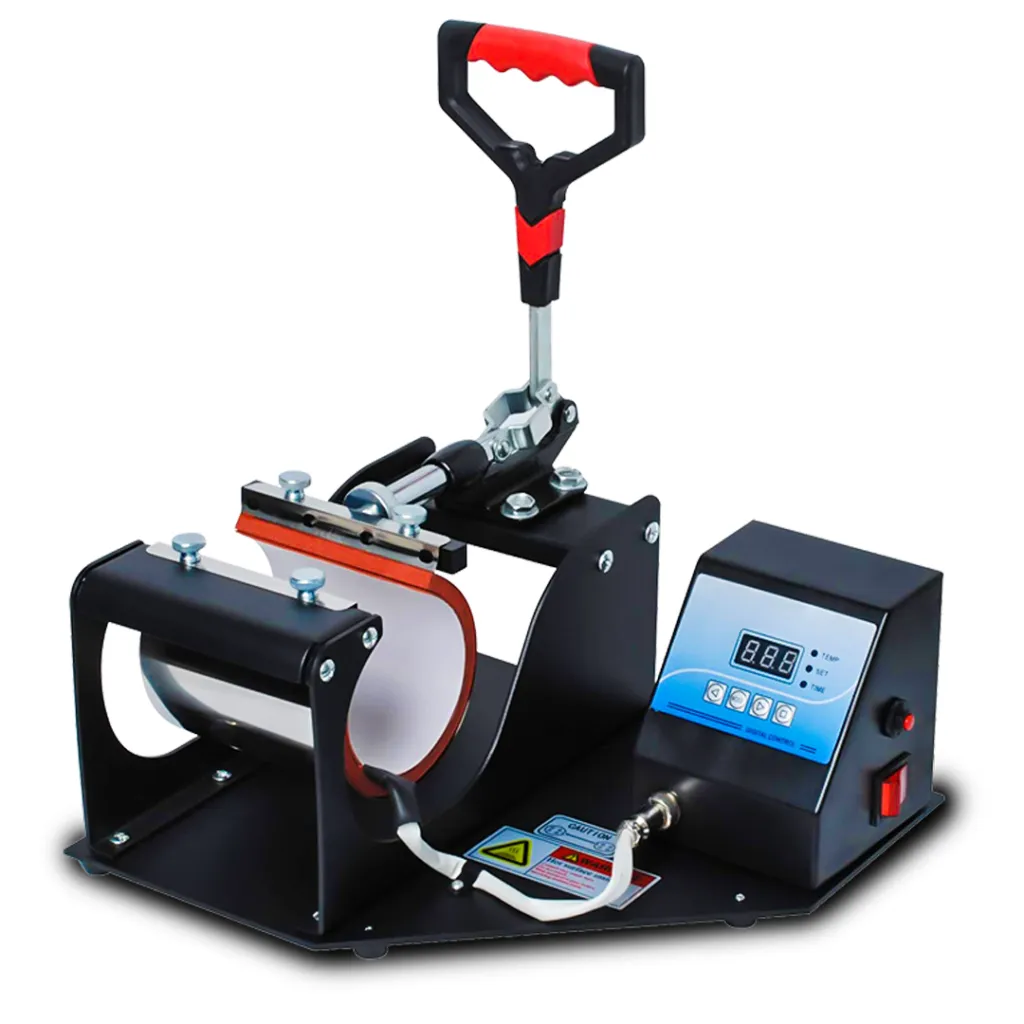
| Mug heat press | Heats the mug evenly with the paper wrapped around it | Mug heat press machines |
| Flat-bed or 3D press (optional) | For tiles, frames, rocks and crystals | Flat-bed heat presses or the ST-3042 3D heat press |
| Sublimation mugs | Coated blanks that accept the print | Sublimation mugs |
| Heat-resistant gloves, scissors, a clean work table | Safety and neat finishing | Local hardware or stationery shops |
Our mugs and gifts starter package brings these together: a mug heat press (plus a flat press for tiles and frames), sublimation paper and tape, and starting stock of mugs, tiles, glass frames and photo rocks. It is adjusted to your budget and space, and quoted on the day because prices move with the exchange rate.
Step by step: pressing your first photo mug
- Prepare the design. Measure the printable area of your mug, or ask us for the dimensions of the mug you buy, and create a canvas at that size at 300 DPI. Leave a little space near the handle and the rim.
- Mirror the image. For ceramic mugs, print the design mirrored so it reads correctly after transfer.
- Print on the correct side of the sublimation paper. Let the ink dry for a moment before handling.
- Trim and wrap. Cut the paper close to the design, wrap it around the mug with the printed side against the surface, and fix it firmly with heat-resistant tape. Loose paper causes blurred or doubled images.
- Heat the press. The Help Center starting point for a ceramic mug in a mug press is 180 °C for 3 minutes with moderate pressure. In a 3D press, it is 180 °C for 8 minutes.
- Press. Place the mug, close the press to a snug fit and start the timer.
- Remove carefully. The mug will be very hot. Wear heat-resistant gloves, peel the paper away promptly and let the mug cool on a heat-safe surface.
- Inspect. Check colour, sharpness and edges in daylight before packing.
These settings are starting points. Presses vary, so always test on a spare mug and adjust. You can find the full list for other materials in our heat press temperature and time guide.
Fixing common sublimation mug problems
| Problem | Likely cause | What to try |
|---|---|---|
| Faded or dull colours | Temperature too low, time too short, or not a sublimation mug | Check the press temperature and time; confirm the blank is coated |
| Blurred or double image (ghosting) | Paper moved during or after pressing | Tape the paper more tightly; peel in one movement |
| Pale patch on one side | Uneven pressure | Adjust the press so it closes evenly around the mug |
| Image reads backwards | Design not mirrored | Mirror ceramic mug designs before printing |
| Colours different from the screen | Printer settings or colour management | Print a colour test mug and adjust settings; show customers a real sample |
| Pixelated photo | Low-resolution image from the customer | Ask for the original photo file rather than a screenshot |
Taking orders: what to ask every customer
Personalised orders often arrive on WhatsApp or Facebook Messenger. A short, consistent set of questions saves time and prevents mistakes:
- Which mug type (white, magic, gold rim and so on) and how many?
- The original photo, sent as a file or document rather than a compressed image, if possible.
- Exact names, dates and messages, typed out so you can copy them without spelling errors.
- Delivery date, and whether it is a collection or courier delivery.
- Payment method: advance payment or cash on delivery.
Before printing, send a digital proof and ask the customer to confirm it in writing. A confirmed proof protects you if someone later says the name was spelt differently.
Growing from mugs into a gift range
Once you are confident with mugs, the same printer and inks open up many more products. Here are Help Center starting points for popular gift blanks:
| Product | Print orientation | Pressure | Press, temperature and time |
|---|---|---|---|
| Ceramic tiles | Mirror | Moderate | Flat-bed 180 °C, 200–240 s; 3D 180 °C, 6 min |
| Glass frames | Straight | Moderate | Flat-bed 180 °C, 150–180 s; 3D 180 °C, 6 min |
| Photo rocks | Mirror | Moderate | Flat-bed 180 °C, 200–240 s; 3D 180 °C, 8 min |
| Photo crystals | Straight | Moderate | Flat-bed 180 °C, 200–300 s; 3D 180 °C, 10–13 min |
| Metal | Mirror | High | Flat-bed 180 °C, 60 s; 3D 180 °C, 3.5–4 min |
| MDF wood | Mirror | High | Flat-bed 160 °C, 150 s; 3D 180 °C, 4–5 min |
Within mugs, you can also add variety with the conical magic mug, glitter magic mugs, gold rim mugs and bone china mugs. Ask us for the right pressing guidance for each speciality blank before you start.
Planning around Sri Lankan gifting seasons
Personalised gifts follow the calendar. Prepare designs, blanks and packaging before these periods:
- Valentine’s Day, Mother’s Day and Father’s Day: couple mugs, “best mum” designs, photo rocks.
- Sinhala and Tamil New Year: family photo gifts and greeting mugs for relatives.
- Christmas, Eid, Deepavali and Thai Pongal: respectful greeting designs, gift sets for colleagues.
- Graduation and convocation: photo crystals and framed photos.
- Weddings and homecomings: thank-you mugs and keepsake frames.
- Company events: branded mugs for staff and clients, often in bulk.
Our guide to the Sri Lankan printing calendar goes through the year month by month.
Packing, delivery and pricing
Ceramic and glass break. Wrap each item in bubble wrap, use a sturdy box with padding on all sides, and mark parcels as fragile. For courier orders, get a quote from your courier and decide in advance who pays for a breakage. Keep a small allowance in your price for the occasional broken or misprinted item.
When you work out your price, include the mug, paper, ink, tape, box, electricity, your time and that breakage allowance, not just the blank. Our guide on how to price printed t-shirts, mugs and gifts for profit includes a costing table you can copy and fill in with your own quotes.
Frequently asked questions
Can I print on any ceramic mug with sublimation?
No. Sublimation only bonds with polyester or polymer-coated surfaces, so you need mugs made for sublimation. An uncoated mug will not hold the image.
What temperature and time should I use for a sublimation mug?
A good starting point is 180 °C for 3 minutes with moderate pressure in a mug press, or 180 °C for 8 minutes in a 3D press. Test on a spare mug and adjust for your machine.
Do I need to mirror the design for a mug?
Yes, for ceramic mugs, print the design mirrored. Glass and crystal items are printed straight, so check the orientation for each product.
Can I start a photo mug business from home?
Yes. A sublimation printer, a mug press, sublimation paper and tape and a stock of mugs fit on a table. Check that your electrical supply suits a heat press before you begin.
See a mug press working
The easiest way to decide is to watch a mug being pressed. Visit our showroom at 382 Galle Road, Colombo 06, or message us on WhatsApp at 077 762 8679 and tell us what you plan to sell. We will quote the equipment and blanks for your budget, and our machines come with installation, training and spare parts.