Start a T-Shirt Printing Business in Sri Lanka on a Budget
A low-budget, low-risk way to start printing t-shirts from home in Sri Lanka: press-only set-up, niche ideas, a cost and profit worksheet using your own quotes, and a 30-day launch plan.
In this guide 10 sections
- Be realistic before you spend anything
- Choose a starting model that fits your budget
- Starter equipment for a t-shirt printing business in Sri Lanka
- Pick a niche instead of printing for everyone
- Work out your numbers before you buy
- The practical admin
- Your first 30 days
- Mistakes to avoid
- Frequently asked questions
- Take the first step
You do not need a factory, a large loan or a shop on the main road to start a t-shirt printing business in Sri Lanka. You can begin at home with one heat press, a small stock of blank t-shirts and printed transfers they order as needed. What you do need is a clear plan, honest numbers and a realistic idea of the work involved.
This guide walks you through a low-budget way to start: the equipment you actually need, how to pick a niche, how to work out your cost and profit per shirt with your own figures, and a simple 30-day plan to get your first orders. We will not promise you a monthly income, because nobody honestly can. We will show you how to test the idea without risking more than you need to.
Be realistic before you spend anything
Printing t-shirts is straightforward to learn, but running a business around it takes more than pressing. Expect to spend time on:
- Designing or sourcing artwork, and checking files before printing.
- Talking to customers on WhatsApp, taking sizes and confirming details.
- Pressing, checking, folding and packing each order.
- Arranging delivery and collecting payments.
- Promoting your work consistently, even when orders are slow.
Some weeks will be busy around events and festivals, and some will be quiet. Starting small lets you learn which designs and customers work for you before you invest in bigger machines.
Choose a starting model that fits your budget
The biggest budget decision is whether you print transfers yourself or buy them. For most beginners, buying transfers first is the lower-risk route.
| Stage | How it works | Equipment you need | Good for |
|---|---|---|---|
| 1. Press-only | Order DTF transfers from a printing service and press them yourself | Heat press, blanks, Teflon sheet | Testing the market with small orders |
| 2. Add personalisation | Add names, numbers and text in vinyl alongside DTF prints | Plus a cutting plotter, vinyl and weeding tools | Sports kits, birthday and family t-shirts |
| 3. Print in-house | Run your own DTF printer once volume is steady | Plus a DTF printer, film, inks and powder | Regular, higher-volume orders |
Stage 1 keeps your spending focused on a heat press and blanks. When you are ready to think about stage 3, our guide on whether to buy transfers or your own DTF printer helps you decide.
Starter equipment for a t-shirt printing business in Sri Lanka
Here is what a press-only t-shirt business needs. Machine and blank prices change with the exchange rate, so ask us on WhatsApp for today’s quote rather than relying on an old figure.
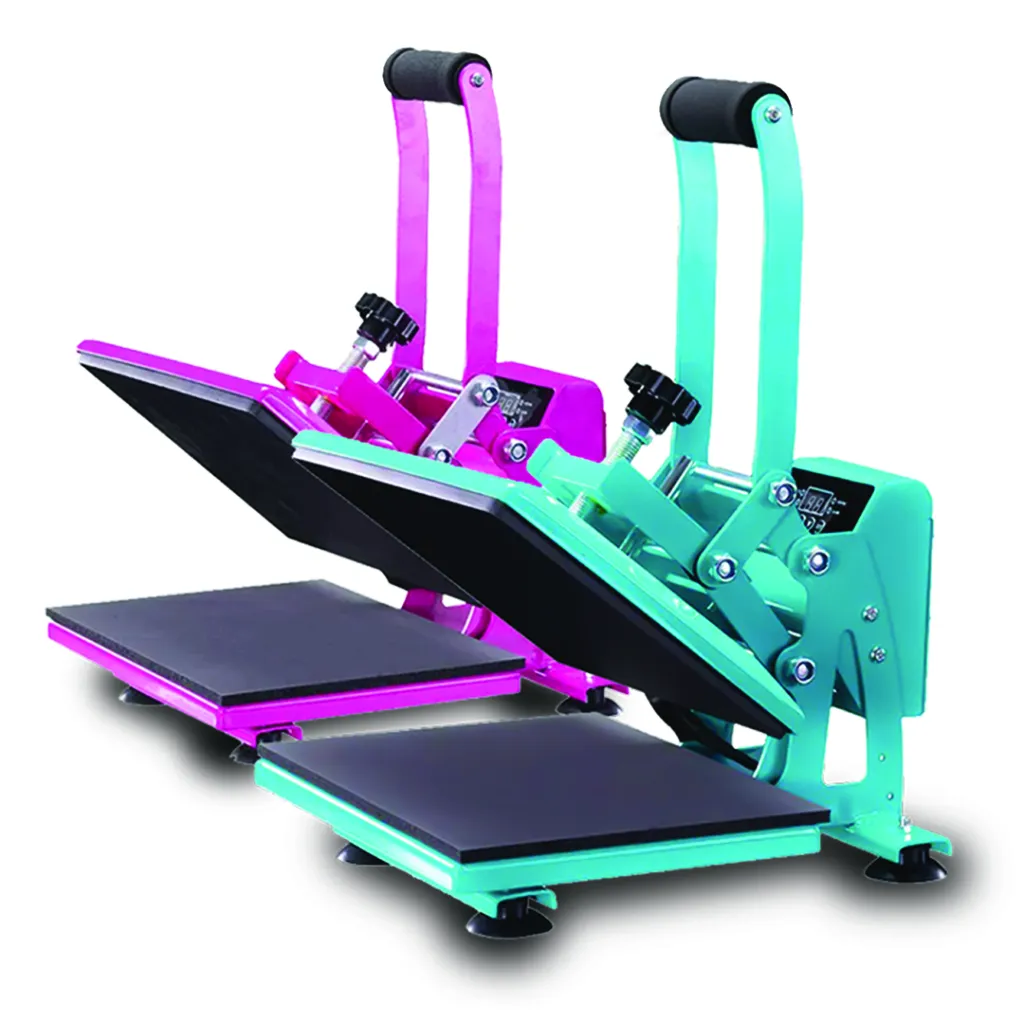
- A flat-bed heat press. A 15″ × 15″ press or larger handles adult t-shirt fronts comfortably. Compare sizes in our flat-bed heat press machines range.
- Blank t-shirts. Start with the colours and sizes you expect to sell most. Our 220 GSM premium cotton t-shirts come in black, white and five light colours, sizes S to 3XL.
- DTF transfers printed from your artwork (prices below).
- Teflon sheet or parchment to protect prints and the press.
- A steady table, a ruler or t-shirt alignment guide, and good lighting.
- Packaging: bags, labels and a simple care card.
- A safe power supply. Heat presses draw a lot of power. Read our heat press power connection guide before you plug in.
If you would rather buy everything together, our starter packages include a custom t-shirt (DTF) option with a flat-bed press, DTF consumables and cotton blanks, adjusted to your budget and space. Our machines come with installation, training and spare parts, and you can watch a machine run in the showroom before buying.
Pick a niche instead of printing for everyone
“Custom t-shirts for anyone” is hard to promote. A clear niche makes your designs, pricing and marketing easier. Some ideas that suit the Sri Lankan calendar and community life:
- School events: inter-house sports meet t-shirts, batch and leavers’ shirts, society shirts.
- Tuition classes: branded shirts for students and teachers.
- Sports clubs and big-match supporters.
- Family occasions: weddings, homecomings, birthdays and family trips with matching or named shirts.
- Company and staff event t-shirts.
- Community occasions: dansal volunteer shirts for Vesak or Poson, or organising team shirts for festivals and charity events, designed respectfully.
- Your own design label: a small range of original designs sold online.
Choose one or two to start. You can always widen later.
Work out your numbers before you buy
This is the most important part of starting a t-shirt printing business in Sri Lanka on a small budget. You need to know what each shirt costs you, what you will charge, and how many you must sell to cover your equipment.
Transfer prices at the time of writing
| Size | Print area | Price | Bulk price |
|---|---|---|---|
| A4 sheet | 8″ × 11″ | LKR 240 per sheet | LKR 200 from 51 sheets |
| A3 sheet | 11″ × 16″ | LKR 450 per sheet | LKR 400 from 51 sheets |
| Gang sheet, 11″ wide | 11″ × 39″ | LKR 1,200 per metre | LKR 1,000 from 16 m |
| Roll, 22″ wide | 22″ × 39″ | LKR 2,400 per metre | LKR 2,000 from 16 m |
Check our DTF printing page for today’s price before you set your own prices.
Worked example: cost and profit per shirt
Suppose you sell a t-shirt with one front design that fits an A4 sheet. Fill in the blanks with your own quotes.
| Item | Amount per shirt |
|---|---|
| DTF transfer (A4 sheet) | LKR 240 |
| Blank t-shirt | A = your quote |
| Packaging and care card | B = your figure |
| Delivery, if you pay it | C = your courier’s rate |
| Payment or platform fees, if any | D = your figure |
| Total cost per shirt | 240 + A + B + C + D |
Then:
- Profit per shirt = your selling price − total cost per shirt.
- Shirts needed to cover your heat press = heat press price (your quote) ÷ profit per shirt.
Two things help your margin once orders grow. First, at 51 A4 sheets the price drops to LKR 200 each, so an order of 51 sheets (LKR 10,200) costs less than 50 sheets at the standard price (LKR 12,000). Second, small designs such as pocket logos are usually cheaper per print when grouped on a gang sheet. Remember to value your own time too; if a price only works when your hours are free, it will not last. Our guide to pricing printed t-shirts for profit goes deeper.
The practical admin
- Business name: if you plan to trade under a brand name, check the current registration requirements with your Divisional Secretariat.
- WhatsApp Business: set up a catalogue, a greeting message and quick replies for sizes and pricing.
- Payments: decide whether you take bank transfers, cash on collection or cash on delivery through a courier, and ask for an advance on large custom orders.
- Order form: a simple list of name, size, colour, quantity, design and delivery date for every order avoids costly mistakes.
- Records: note every sale and expense from day one, even in a notebook or spreadsheet.
Your first 30 days
- Week 1: choose your niche, prepare three to five designs using the artwork checklist in our guide to DTF printing, and get quotes for your press and blanks.
- Week 2: order a small batch of transfers, press samples on spare shirts, and practise until every print is straight and fully bonded.
- Week 3: photograph the samples in good daylight, set up your WhatsApp Business catalogue and Facebook or Instagram page, and share with friends, family, schools and clubs you know.
- Week 4: take your first orders, deliver carefully, ask happy customers for photos you can share with their permission, and review which designs got the most interest.
When you are ready to reach more buyers, read how to sell printed products online in Sri Lanka.
Mistakes to avoid
- Buying a large machine before you have regular orders.
- Printing a big stock of one design in every size before testing it.
- Using low-resolution images or screenshots for artwork.
- Skipping test presses on a new fabric or garment.
- Pricing to match the cheapest seller instead of covering your real costs.
- Taking custom orders without confirming names, sizes and spelling in writing.
Frequently asked questions
Can I start a t-shirt printing business from home?
Yes. A press-only set-up needs a heat press, blank t-shirts, ordered DTF transfers and a safe power supply, which fits in a small room. Check local requirements if you plan to register a business name.
Do I need my own DTF printer to start?
No. You can order DTF transfers printed from your artwork and press them yourself. A printer of your own is worth considering once you have steady, regular orders.
How much money do I need to start?
It depends on the heat press size, how many blanks you stock and your first transfer order. Machine and blank prices move with the exchange rate, so ask us on WhatsApp for today’s quote.
How do I calculate profit on each t-shirt?
Add the transfer, blank, packaging, delivery and any fees to get your cost per shirt, then subtract that from your selling price. At the time of writing, an A4 DTF transfer is LKR 240.
What heat press settings should I use for cotton t-shirts?
For DTF transfers on cotton, start at 160 °C for 25 seconds with firm pressure, and let the print cool completely before peeling. Test on a spare shirt first.
Take the first step
Tell us what you want to print and roughly how much you want to spend, and we will suggest a sensible starting set-up. Message us on WhatsApp at 077 762 8679, call 011 438 6668, or visit our showroom at 382 Galle Road, Colombo 06, to see a heat press in action before you buy.