How to Price Printed T-Shirts, Mugs and Gifts for Profit
A step-by-step pricing method for printed t-shirts, mugs and gifts: a costing table to copy, a worked example using Print Right's published DTF prices, margin versus markup, and bulk order pricing.
In this guide 9 sections
- Step 1: List every cost, not just the blank
- Step 2: How to price printed t-shirts with a costing table
- Step 3: Understand margin and markup
- Step 4: Price bulk orders without losing money
- Step 5: Check your price against the market
- Step 6: Set clear extra charges
- Common pricing mistakes to avoid
- Frequently asked questions
- Get the numbers you need
A printing business can be busy every day and still earn very little if the prices are wrong. If you are working out how to price printed t-shirts, mugs and gifts, the answer is not to copy the cheapest seller on Facebook. It is to know your full cost per item, decide the profit you need, and then check that the price makes sense to your customers.
This guide walks you through that process with a costing table you can copy, a worked t-shirt example using our published DTF transfer prices, and simple formulas for margin, markup and bulk discounts. Where we do not have a real figure, such as the price of your blank t-shirt or your courier fee, we use clearly marked example figures. Replace them with your own quotes.
Step 1: List every cost, not just the blank
A frequent pricing mistake is counting only the t-shirt and the print. A real cost per item includes:
- Materials: the blank t-shirt, mug or frame, plus the transfer, sublimation paper, ink and tape.
- Packaging: bags, boxes, bubble wrap, labels, thank-you cards.
- Running costs: electricity for the heat press and printer, and wear on machines and Teflon sheets.
- Your time: design changes, messaging the customer, pressing, checking and packing. Put a value on your hour, even if you work from home.
- Wastage: the misprint, the crooked transfer, the mug that cracked. It will happen, so plan for it.
- Overheads: phone and data, advertising, rent if you have a shop, and a share of what you paid for your machines.
- Selling costs: marketplace fees, payment charges and cash-on-delivery returns.
Step 2: How to price printed t-shirts with a costing table
Below is a costing table for one t-shirt with a full-front DTF print. The DTF transfer price is our published price at the time of writing (check the DTF printing page for today’s price). Every other figure is an example figure, not a real price. Use your own quote. The final column is empty for you to fill in.
| Cost line | How to calculate | T-shirt example (LKR) | Your product (LKR) |
|---|---|---|---|
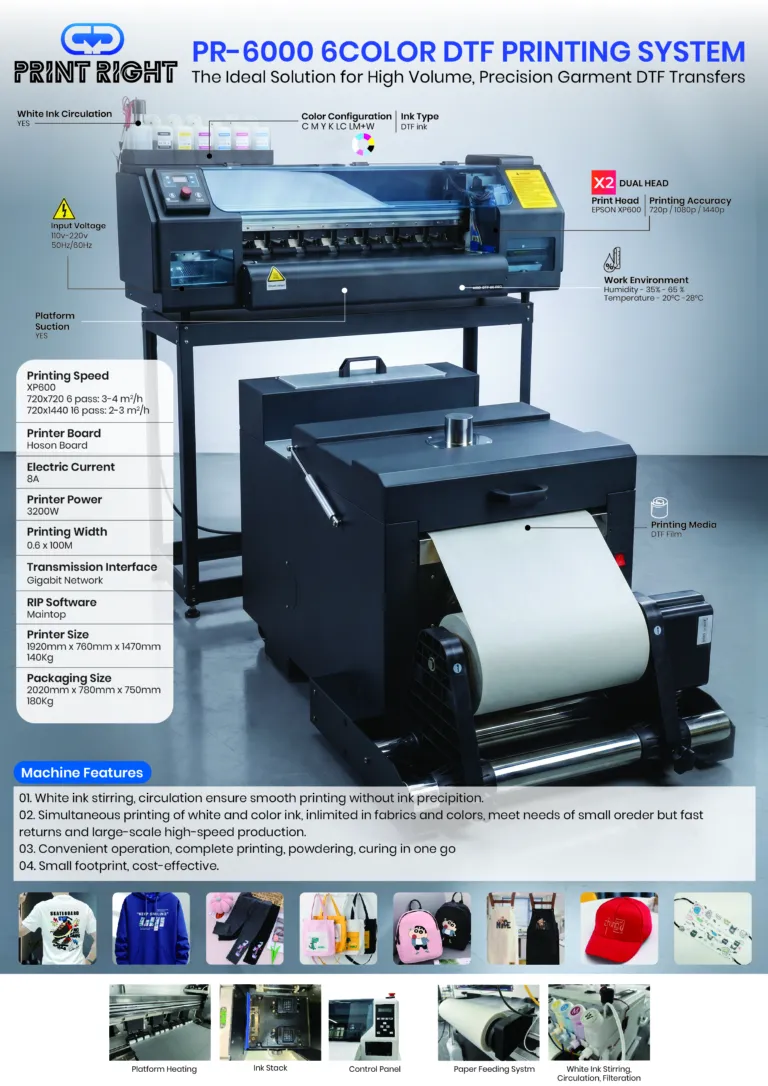
| Print or transfer | A4 DTF sheet, LKR 240 each (published price) | 240 | |
| Blank item | Your supplier’s quote per piece | 1,000 (example figure) | |
| Packaging | Bag, label, card | 50 (example figure) | |
| Electricity and machine wear | Your estimate per item | 30 (example figure) | |
| Labour | Minutes per item × your hourly value ÷ 60 (example: 10 minutes at LKR 600 an hour) | 100 (example figure) | |
| Wastage allowance | 5% of print + blank + packaging (example rate) | 65 | |
| Overhead share | Monthly overheads ÷ items you expect to sell per month | 100 (example figure) | |
| Total cost per item | Add all lines | 1,585 | |
| Target margin | Your choice | 40% | |
| Selling price | Total cost ÷ (1 − margin) | 2,641.67, rounded to 2,650 |
Delivery is often charged separately, so it is not in this table. If you include “free delivery”, add your courier quote as another cost line.
For a mug or gift, use the same table and change the lines. The print line becomes sublimation paper, ink and tape per item; the blank becomes your sublimation mug or frame; packaging usually costs more because of the box and bubble wrap; and your wastage allowance may need to be higher because ceramic and glass can break. Our photo mug and gift business guide covers the mug process itself.
Step 3: Understand margin and markup
These two words are often mixed up, and the difference changes your price.
- Markup is profit as a percentage of cost. In the example, profit is 2,650 − 1,585 = LKR 1,065, so markup is 1,065 ÷ 1,585 = about 67%.
- Margin is profit as a percentage of the selling price. The same LKR 1,065 is 1,065 ÷ 2,650 = about 40% margin.
If you add “40% on top of cost”, you get a 40% markup, which is only about a 29% margin. Decide which one you mean, and use the formula price = cost ÷ (1 − margin) when you want a specific margin.
The right margin depends on your business. A personalised one-off gift involves messaging, proofs and careful handling, so it usually needs a healthier margin than a repeat bulk order of the same design.
Step 4: Price bulk orders without losing money
Schools, clubs and companies often ask for a lower price per piece on larger orders. That is reasonable, because some of your costs do fall. The key is to recalculate, not just knock off a round amount.
Our own DTF prices show how volume changes cost. At the time of writing:
| Format | Print area | Standard price | Bulk price |
|---|---|---|---|
| A4 sheet | 8″ × 11″ | LKR 240 per sheet | LKR 200 per sheet from 51 sheets |
| A3 sheet | 11″ × 16″ | LKR 450 per sheet | LKR 400 per sheet from 51 sheets |
| 1 m gang sheet, 11″ wide | 11″ × 39″ | LKR 1,200 per metre | LKR 1,000 per metre from 16 m |
| 1 m roll, 22″ wide | 22″ × 39″ | LKR 2,400 per metre | LKR 2,000 per metre from 16 m |
Worked example: 60 t-shirts for a company event
With 60 full-front prints, the transfer drops from LKR 240 to LKR 200. Recalculating the example table: print 200 + blank 1,000 + packaging 50 + electricity 30 + labour 100 + wastage 63 (5% of 1,250) + overhead 100 = LKR 1,543 per shirt. If you accept a 30% margin on this bulk order, the price is 1,543 ÷ 0.70 = LKR 2,204.29, which you might round to LKR 2,205.
Ask your blank supplier for a bulk quote too. If your blank cost falls, run the numbers again. For more on winning these orders, see our guide to bulk printing orders from schools and companies.
Cost per design on gang sheets
When an order has many small designs, such as chest logos or name labels, work out cost per design:
Cost per design = sheet or metre price ÷ number of designs that fit.
For example, if your layout fits 40 small logos on one 22″ × 39″ metre (an example count; the real number depends on your design size and spacing), each logo costs 2,400 ÷ 40 = LKR 60 at the standard price, or 2,000 ÷ 40 = LKR 50 at the bulk price for orders from 16 m. Compare this with the same designs laid out on A4 or A3 sheets and choose the format with the least empty space. Our DTF gang sheet guide explains layout in detail.
Step 5: Check your price against the market
Your cost-based price is the floor. Now check it from the customer’s side:
- Look at comparable products, not just the cheapest ones. A 220 GSM cotton t-shirt with a durable print is not the same product as a thin shirt with a peeling print.
- Consider the occasion. A personalised wedding keepsake or a graduation crystal is bought for its meaning. Customers may judge these on quality and presentation as much as on price.
- If your price is higher than others, explain why. Show close-up photos of print quality, mention the fabric weight, and offer a proof before printing.
- If you cannot compete at a price, do not go below cost. Change the product (a different blank, a smaller print, one print location instead of two) rather than working for nothing.
Step 6: Set clear extra charges
Write these down once and use them consistently in every quote:
- Extra print locations: a back print means another transfer. At our A4 price, that is another LKR 240 of cost before your time and margin.
- Design fee: charge separately for new artwork, or include a set number of changes.
- Names and numbers: each individual name adds layout and checking time.
- Urgent orders: a same-week order may mean late nights or rearranging other jobs.
- Larger sizes: if 2XL and 3XL blanks cost you more, price them accordingly.
- Delivery and cash on delivery: decide who pays the courier fee and what happens if a COD parcel is refused.
Ask for an advance on custom and bulk orders. A personalised item with someone’s name on it cannot be resold if the customer changes their mind.
Common pricing mistakes to avoid
- Leaving out your own time because “I work from home anyway”.
- Forgetting wastage and breakages.
- Offering bulk discounts without recalculating the cost.
- Not updating prices when your supplier quotes change. Machine and blank prices can move with the exchange rate, so re-check your costing table whenever you restock.
- Running frequent sales that remove your whole margin.
Frequently asked questions
What is a good profit margin for printed t-shirts?
There is no single right figure. Calculate your full cost per item first, then choose a margin that covers your time and risk. Personalised one-off items usually need a higher margin than repeat bulk orders.
How do I calculate a selling price from a margin?
Divide your total cost by one minus the margin. For example, a total cost of LKR 1,585 with a 40% margin gives 1,585 ÷ 0.60, which is about LKR 2,642.
How much does a DTF transfer cost for one t-shirt?
At the time of writing, Print Right’s A4 DTF sheet is LKR 240, or LKR 200 per sheet from 51 sheets. Check the DTF printing page for today’s price.
Should I include delivery in my price?
You can charge delivery separately or include it. If you offer free delivery, add your courier quote to your costing table so it does not come out of your profit.
Get the numbers you need
A costing table is only as good as the figures in it. Message us on WhatsApp at 077 762 8679 for today’s quote on t-shirt blanks, mugs and gift blanks, or use our request a quote page. You can also send your artwork for DTF printing and collect from our showroom at 382 Galle Road, Colombo 06.